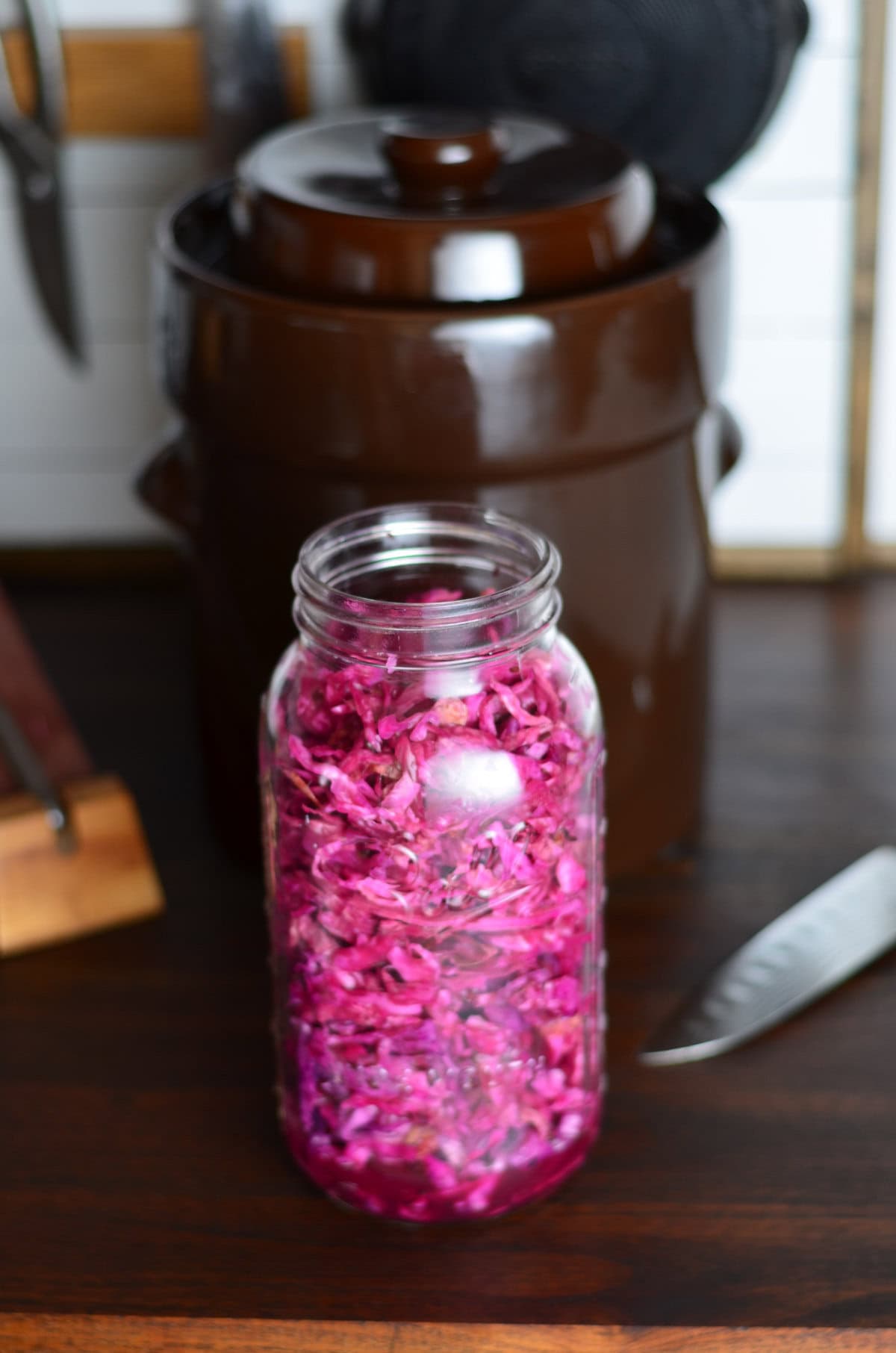
Homemade Sauerkraut
Homemade sauerkraut is made with thinly sliced cabbage and kosher salt, then packed down until it releases its own brine and ferments until it tastes the way you like. It is a simple fermented cabbage recipe for sandwiches, sausages, braised meats, and other savory dishes.
Equipment
- 4-liter capacity or larger ceramic crock (with provided weights and lid) Option 1
- Food-grade plastic bucket, plate to fit inside the bucket, 1 gallon jug filled with water, cheesecloth, or towel to cover the bucket. Option 2
Ingredients
- 5 pounds cabbage
- 3 tablespoons kosher salt
Instructions
- Chop the cabbage thinly with a knife, grate, or shave with a mandoline.
- Add the cabbage to a large bowl or food-safe plastic tub. Toss to coat. Sprinkle with salt as you do so.
- Add the cabbage to your crock or bucket one handful at a time, pressing it down firmly with your fist after each addition. Pressing helps pack the cabbage tightly, and forces water out.
- Place the weights inside of the crock. If using a bucket, place the plate and the gallon jug of water on top. Cover the crock with its lid. Cover with a bucket, and secure with a towel or cheesecloth. Press down on your weights every couple of hours to help draw out water from the cabbage. Do this until the water level has risen above the cabbage. This can take up to 24 hours. If after 24 hours, the water level is not above the cabbage, add salted water with a ratio of 1 tablespoon to 1 cup of water to the container until it rises above the cabbage. Cover your vessel.
- Place the crock somewhere in your home where you won't forget about it. You'll be checking on it every day or so. Do not worry if you notice any mold; this is simply a bloom. The salty brine protects the sauerkraut. Skim off what you can and cover the vessel back up.
- After about 4 to 5 days, start tasting the sauerkraut for flavor and texture. The flavor gets better and stronger over time. If your vessel is stored in a cool room, your sauerkraut will mature at a much slower rate than if it is stored in a warm environment.
NOTES
- Slice the cabbage thinly. Thin shreds pack down better and release brine more easily. A knife, grater, or mandoline all work.
- Pack it down firmly. Press the cabbage down hard as you add it so it starts giving off liquid and stays tightly packed.
- Keep it under brine. The liquid should rise above the cabbage. If it does not after about 24 hours, add salted water at a ratio of 1 tablespoon salt to 1 cup water until the cabbage is covered.
- Use weights and cover it. Keep the cabbage submerged with weights, a plate, or a jug of water, and cover the vessel while it ferments.
- Press it during the first day. Push down on the weights every couple of hours to help pull more liquid from the cabbage.
- Start tasting after 4 days. Check it after about 4 to 5 days, then let it keep going if you want a stronger flavor. Cooler rooms slow the fermentation down.
- Do not panic over surface bloom. A thin white, gray, or light pink film on the surface is usually yeast, not a failed batch, and it can be skimmed off. If you see fuzzy growth or mold that is green, blue, brown, or black, or the kraut turns slimy or smells bad, discard it.
Nutrition
Calories: 567kcal | Carbohydrates: 132g | Protein: 29g | Fat: 2g | Saturated Fat: 1g | Polyunsaturated Fat: 0.4g | Monounsaturated Fat: 0.4g | Sodium: 21338mg | Potassium: 3860mg | Fiber: 57g | Sugar: 73g | Vitamin A: 2223IU | Vitamin C: 830mg | Calcium: 920mg | Iron: 11mg
Nutrition information is automatically calculated, so should only be used as an approximation. Nutrition is per serving.
Make this recipe?Mention @Larry__White or tag #WildGameGourmet!