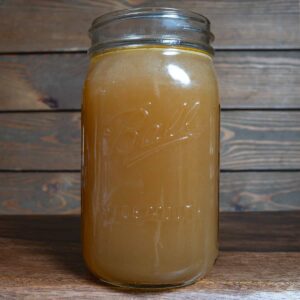
Duck Stock
Roasted duck bones simmered low and slow with vegetables and herbs for a rich homemade duck stock you can use in soups, stews, risotto, and sauces.
Ingredients
- 2 pounds duck bones (backs, legs, necks, wings, or leftover duck carcass)
- 4 quarts water (or more, as needed to cover)
- 1 cup carrots, cut into 1-inch pieces
- ½ cup celery, cut into 1-inch pieces
- ½ medium onion, roughly chopped
- 3 cloves garlic
- 1 tablespoon black peppercorns
- 1 sprig fresh rosemary
- 3 sprigs fresh thyme (2 teaspoons dried thyme)
- 1 bay leaf
Instructions
Roast the bones
- Preheat your oven to 350°F. Arrange the duck bones in a large roasting pan in a single layer. Roast until the bones are golden brown, about 45-60 minutes, turning once or twice.
Transfer to a stock pot
- Move the roasted duck bones to a large stock pot. Add the carrots, celery, onion, garlic, peppercorns, rosemary, thyme, and bay leaf.
Deglaze the roasting pan (optional but recommended)
- If there are browned bits in the roasting pan, add a splash of water, scrape them up with a wooden spoon, and pour the liquid into the stock pot.
Add water
- Pour in cold water until the bones and vegetables are just covered (about 4 quarts; add more as needed).
Simmer gently
- Set the pot over medium heat and slowly bring it up to a simmer. As foam rises to the surface, skim it off with a spoon or ladle. Once it reaches a simmer, lower the heat so the surface barely moves.
- Let the stock cook at a low simmer for 4-5 hours, uncovered or partially covered. Add a little water if the level gets too low. Avoid boiling hard, which can make the stock cloudy.
Strain the stock
- Set a fine-mesh strainer over a large heatproof container. Carefully ladle or pour the stock through the strainer, discarding the solids.
Cool and chill
- Let the strained duck stock cool at room temperature until it's no longer steaming. Transfer to the refrigerator and chill uncovered until completely cold.
Skim fat and store
- Once fully chilled, remove any solidified duck fat and save it separately if you like. Cover the stock and refrigerate for up to 3 days, or transfer to freezer-safe containers and freeze for up to 3 months.
NOTES
Using a roasted duck carcass:
You can use the bones from a duck that has already been roasted. Strip off most of the meat and some of the skin. If the carcass is already deeply browned, you can shorten or skip the roasting step and go straight to the stock pot. Making Duck broth:
If you want to make duck broth, add two or four duck legs (or a combination of the two) with the meat on the bone to the pot during the last two hours of simmering. Duck fat:
Save the fat you skim off the chilled stock. Store it in a jar in the fridge and use it to roast potatoes, vegetables, or sear meat. Instant Pot option: Add the roasted duck bones, vegetables, herbs, and water to the Instant Pot (do not fill past the max line). Cook on High Pressure for 60 minutes, then let the pressure release naturally. Strain, chill, and store as directed in the recipe. Make a gravy: Use this stock to make my duck gravy recipe.
You can use the bones from a duck that has already been roasted. Strip off most of the meat and some of the skin. If the carcass is already deeply browned, you can shorten or skip the roasting step and go straight to the stock pot. Making Duck broth:
If you want to make duck broth, add two or four duck legs (or a combination of the two) with the meat on the bone to the pot during the last two hours of simmering. Duck fat:
Save the fat you skim off the chilled stock. Store it in a jar in the fridge and use it to roast potatoes, vegetables, or sear meat. Instant Pot option: Add the roasted duck bones, vegetables, herbs, and water to the Instant Pot (do not fill past the max line). Cook on High Pressure for 60 minutes, then let the pressure release naturally. Strain, chill, and store as directed in the recipe. Make a gravy: Use this stock to make my duck gravy recipe.
Nutrition
Calories: 41kcal | Carbohydrates: 10g | Protein: 1g | Fat: 0.3g | Saturated Fat: 0.1g | Polyunsaturated Fat: 0.1g | Monounsaturated Fat: 0.04g | Sodium: 108mg | Potassium: 270mg | Fiber: 3g | Sugar: 3g | Vitamin A: 7273IU | Vitamin C: 7mg | Calcium: 88mg | Iron: 1mg
Nutrition information is automatically calculated, so should only be used as an approximation. Nutrition is per serving.
Make this recipe?Mention @Larry__White or tag #WildGameGourmet!