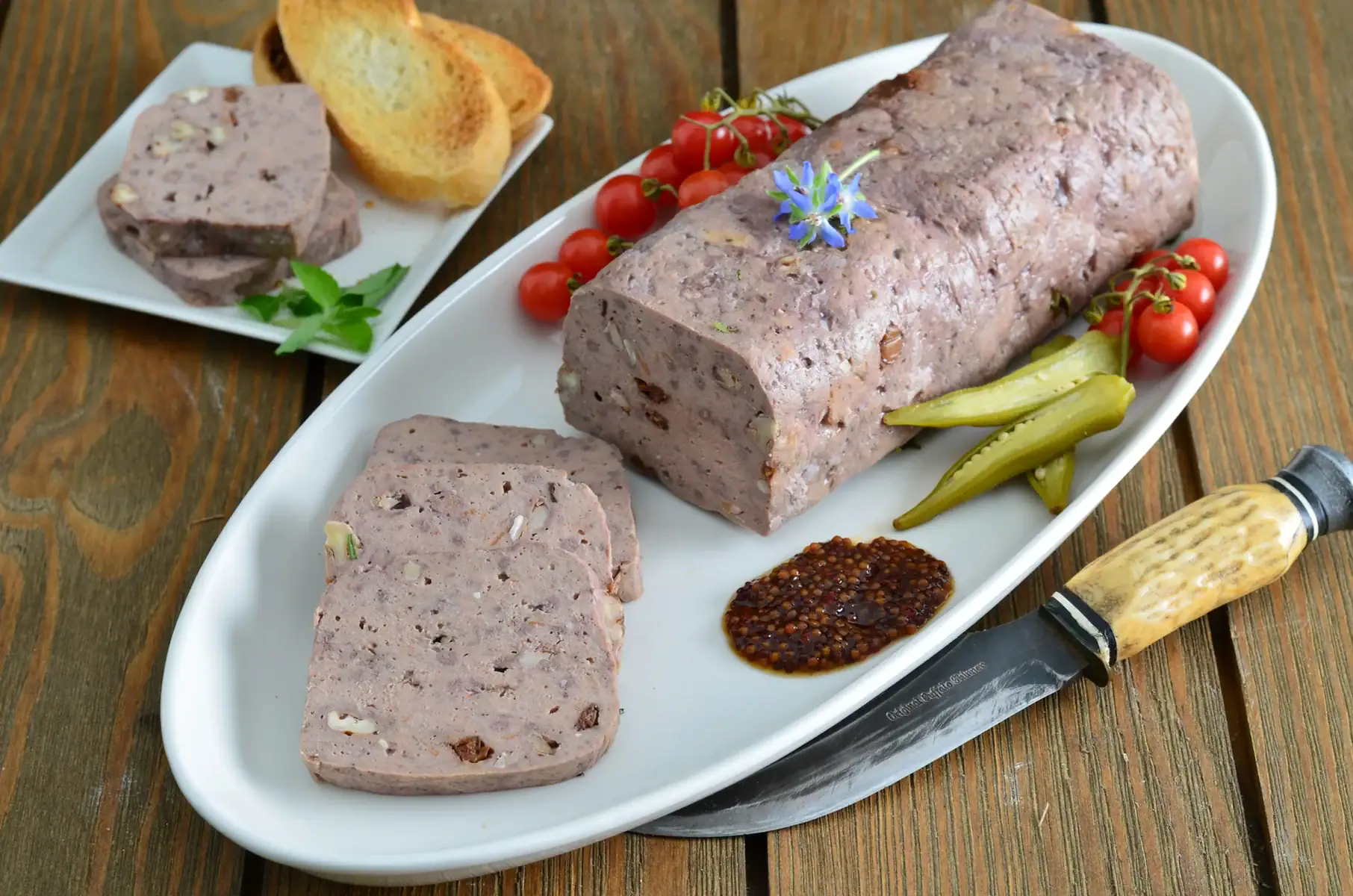
It doesn’t get much more traditional in the world of classic cold dishes than a venison terrine. Though they can look complicated to make, they are essentially just a big loaf of sausage. So if you are pretty decent at making sausages, you shouldn’t have any trouble making a terrine.
I always grind my own deer meat for sausages to control fat content and texture. If you’re new to the process, this grinding venison guide covers everything you need.
The foundation of all wild game terrines will always be what’s called a “forcemeat”, which basically means pureed or ground meat. Tougher cuts from the shoulders and hind legs work best.
You’ll see four different styles of forcemeats on this site: straight, country, gratin, and mousseline.
To keep things simple and make the learning process easier, I’m going to cover the straight forcemeat style. I’ve added a recipe below the tutorial for you to try. If you’re interested in learning about the other forcemeat styles, don’t worry, I’ll cover them in separate posts along with a recipe for each.
Let’s get started!
What is a forcemeat?: A forcemeat is a lean meat and fat emulsion that is established when the ingredients are processed together by grinding, pureeing or sieving. It should not just be a mixture, but a true emulsion so that when it is sliced, it will hold its shape and not fall apart on you.
What is a straight forcemeat?: A straight forcemeat combines your uncooked dominant meat (usually wild boar, bear, or venison) and whatever fat that you are using (usually pork). Often but not always, a secondary meat is added, which is where your game birds, rabbits, or squirrels meat usually comes into play. Cut the meats and fat into cubes, then season, cure, rest, grind, and puree in a food processor.
SALT AND SEASONINGS: As with all cooking, salt plays a major role when making straight forcemeat terrines. Salt draws out the proteins in the meat, which help you achieve the primary bind and adds another depth of flavor. Seasoning and marinating do what you’d expect: they enhance flavor. This can come in the form of grain-based spirits, herbs, vegetables, and wine.
SECONDARY BINDERS: The proteins in meat are the first level of structure and bind for forcemeats. Sometimes you need to add a secondary binder to help things set up a little better. These are usually made with eggs, nonfat milk powder, and panadas. Panadas are made from cooked potatoes or rice, bread soaked in milk, or a dough made from flour, water, butter, and eggs.
NOW HOW TO MAKE A STRAIGHT FORCEMEAT
Chill your ingredients and equipment
Having your ingredients and equipment very cold is paramount when making a forcemeat. Having these cold plays a few major roles. It reduces the chance of foodborne illness, ensures the fat won’t melt and ruin your forcemeat, and improves the flavor of the finished product. So chill your grinder attachments in the freezer for about an hour to be safe. You’ll also want to chill any bowls you use throughout the process.
Grinding
The number one piece of kitchen equipment for a straight style terrine is your meat grinder. For a straight forcemeat, a medium or fine die will work. If you’re into progressive grinding you can always start off with a larger die and then regrind with a smaller one, it this usually isn’t necessary.
Processing
Once ground, it’s time to process the meat with any other ingredients that you are using. Processing helps develop the myosin and gives the meat a slightly tacky texture, which in turn helps it bind better. In some recipes, this would be the time when you’d add in an egg for an even better bind or a little heavy cream to give a smoother texture and richer flavor.
Testing your forcemeat
It’s always a good idea to test your forcemeats before cooking the final product. You can do this by taking about a heaping tablespoon of the mixture, wrapping it in plastic wrap, and poaching it in water that’s around 170 degrees F. This won’t give you the exact flavor and texture of your final terrine, but it will be pretty close.
Remember, you’ll most likely be serving the terrine cold, and cold food needs a little more salt than hot food. If your poached forcemeat tastes just right while it’s hot, add in a touch more salt. Also add any other seasonings you think it needs, because once it goes into the oven, it’s too late! Once you have the seasoning to your liking, add any garnishes you want. This could be dried fruits, toasted nuts, herbs, or a way to sneak in odd bits, such as braised venison tongue cut into a small dice.
Types of Cooking Vessels
You can use a number of cooking vessels to cook your terrines. You can use anything from Pyrex loaf pans and your grandma’s old meatloaf pans to pans dedicated to making terrines. The dedicated terrine pans are usually made of enameled cast-iron, stoneware, stainless steel or even non-stick coated pans. The shapes can vary, but that is mainly for looks. The main thing to worry about is that it is sturdy and not oversized. If you’re interested in buying a terrine mold, Le Creuset makes some of the best. You can also find them on Amazon.com and JB Prince.
Making Your Terrine
- Prep your terrine vessel by lining it with plastic wrap. The plastic wrap makes it easier to remove the meat before serving. The plastic should overhang the vessel enough that, when it’s filled, the forcemeat is completely covered.
- Fill the terrine mold with your forcemeat. Use a rubber spatula to work the mixture tightly into the crevices of the vessel. Fold the overhanging plastic wrap over the forcemeat so that it is completely covered. Tap the vessel on the countertop a few times to remove any air pockets. Cover the terrine with aluminum foil or a lid, if your vessel came with one.
- Cook the terrine gently in a water-bath. To keep the terrine’s fat from separating, cook it gently. Place your terrine vessel in a high-sided roasting pan and pour in enough hot water to cover about three-quarters of the vessel. Now place it in an oven preheated to 300 degrees F.
- Cook the terrine to the appropriate internal temperature. Most terrines take anywhere from just under an hour to 90 minutes to cook. To be safe, check the terrine’s internal temperature with an instant-read thermometer. Generally, cook pork to 150 degrees F and birds to 160 degrees F. Remember that there will be some carry-over cooking after it is removed from the oven. This means that the temperatures can rise anywhere from five to fifteen degrees.
- Chill, press, and refrigerate your terrine. Remove the terrine from the water-bath and let it cool to room temperature. Now press the terrine to ensure it has the proper density. I’m sure you don’t have a terrine press plate lying around, but it’s easy to make your own. Simply cut a thick piece of cardboard, wood, or plastic to the vessel’s inside dimensions and wrap it in foil. Now set something that’s around 2 pounds on top of the terrine to press it down. A brick turned on its side works perfectly. Lastly, refrigerate the terrine overnight or at least 8 hours before serving. This lets the flavors mature and makes slicing easier.
- Now it’s time to serve! The key point to remember is to use a very sharp non-serrated knife. A meat slicing knife works best. Unwrap your terrine and cut slices anywhere from 1/4 inch to 1/2 inch thick. Most terrines are best served with crusty bread, crackers, assorted mustards, cheeses, pickles, chutneys, and vinaigrettes.
Covered tightly, a terrine will typically stay fresh in the refrigerator up to 10 days.
More Venison Recipes
Below are a few of my favorite recipes using deer meat. Check out my entire 2026 venison recipes for more meal ideas.
- The Best Smoked Venison Backstrap
- Dehydrator Venison Jerky
- Deer Breakfast Sausage
- Venison Summer Sausage
- Venison Stick Recipe
Lastly, if you make this venison terrine recipe, be sure to leave a comment or tag me on Instagram! I thoroughly enjoy hearing feedback and checking out the photos of recipes that you’ve made.
Venison and Wild Boar Terrine
Ingredients
- 1 pound venison shoulder, cut into 1 inch pieces
- 1 pound wild-boar hind leg meat, cut into 1 inch pieces
- 1 pound fatback, cut into 1 inch pieces
- 1/4 cup red wine
- 1/2 teaspoon ground cloves
- 1/2 teaspoon ground nutmeg
- 1/2 teaspoon ground ginger
- 1/2 teaspoon ground coriander
- 1/4 teaspoon (2 grams) pink salt (Optional. This is for color)
- 1 tablespoon ground black pepper
- 2 tablespoons kosher salt
- 1 tablespoon butter
- 1 tablespoon minced garlic
- 2 tablespoon minced onion
- 3 eggs
- 6 ounces heavy cream
- 2 cups dried tart cherries, soaked overnight in brandy and then drained
- 1/2 cup chopped roasted walnuts
Instructions
- Combine the meat, fat, wine, spices, salt, pepper and pink salt into a bowl, cover and refrigerate them overnight.
- In a pan melt the butter and cook your onions and garlic over medium-low heat until soft. Chill in the refrigerator.
- Pre-heat your oven to 300 degrees F.
- Prepare your forcemeat by grinding your marinated meat mixture into a chilled bowl. (Don’t forget to put your grinder parts in the freezer beforehand)
- Add the ground meat mixture, eggs and cooked onions/garlic to your food processor, blend until smooth. Then transfer the mixture back into a chilled bowl. Fold in the heavy cream with a rubber spatula until fully incorporated. Now fold in your drained cherries and walnuts.
- Line your terrine mold with plastic wrap leaving enough overhang to fully cover the terrine.
- Fill the terrine mold with the mixture and cover with the overhanging plastic. Then cover the top of the vessel with aluminum foil or a lid.
- Bake the terrine in a water-bath to an internal temperature of 150 degrees F. This will take about 60-70 minutes.
- Remove the terrine from the water and allow it to cool to room temperature. Apply your handy press-plate that you made and weigh it down with a 2 pound weight. Refrigerate over night and then you’re ready to slice and serve.
NOTES
- Chill everything well. Keep the meat, fat, grinder parts, bowls, and cooked onion mixture cold so the fat stays firm and the forcemeat binds cleanly.
- Marinate the meat overnight. Mix the venison, wild boar, fatback, wine, spices, salt, pepper, and optional pink salt, then refrigerate overnight before grinding.
- Cook the onions before blending. Soften the onion and garlic in butter, then chill them before adding them to the forcemeat so they do not warm the mixture.
- Process until smooth. Grind the marinated meat first, then blend it with the eggs and cooked onion mixture until smooth, then fold in the cream, cherries, and walnuts.
- Pack the mold tightly. Press the mixture firmly into the lined terrine mold and tap out any air pockets so the finished slices hold together better.
- Bake in a water bath. Cook at 300 F until the center reaches 150 F.
- Press and chill overnight. Cool to room temperature, weigh it down with about 2 pounds, and refrigerate overnight so it firms up enough to slice cleanly.
- Slice with a sharp knife. Cut it cold into 1/4-inch to 1/2-inch slices.
Nutrition
Nutrition information is automatically calculated, so should only be used as an approximation. Nutrition is per serving.